
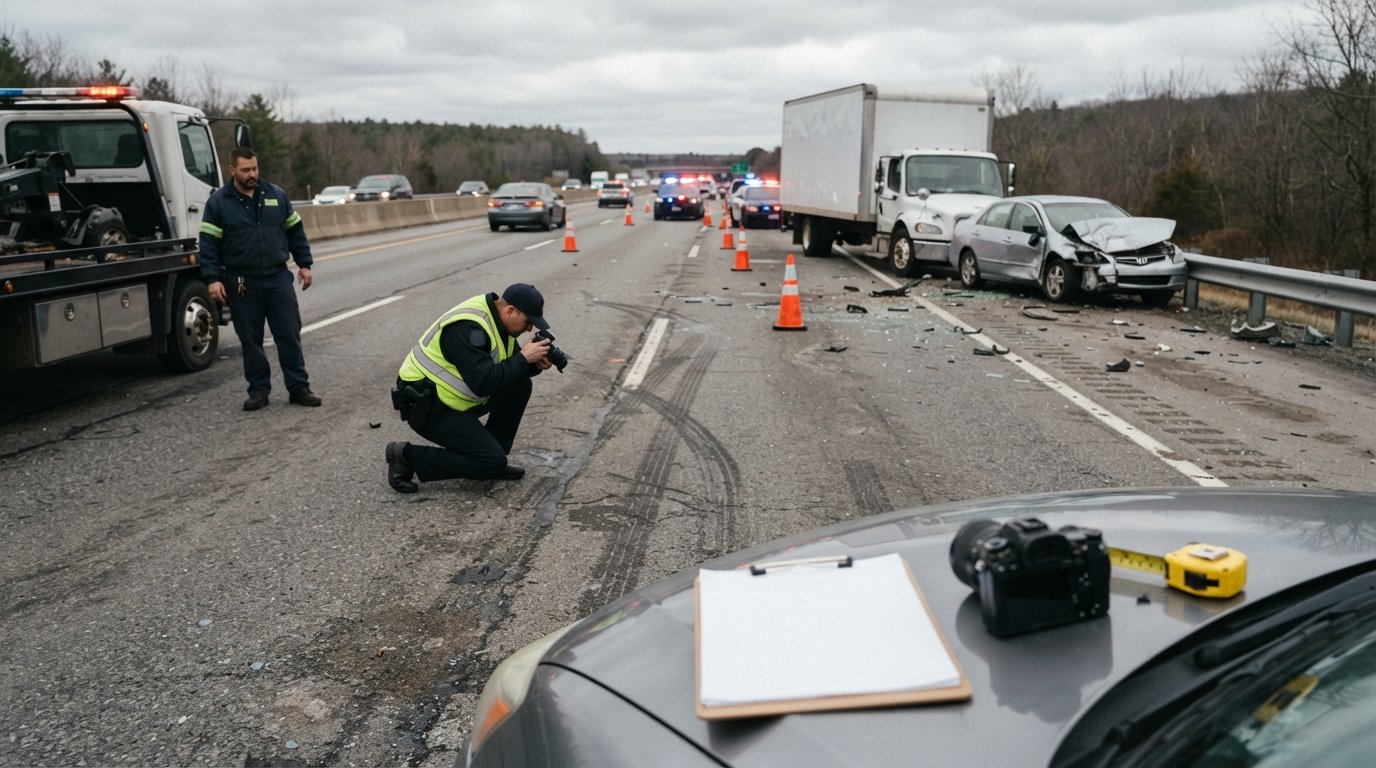
Gathering Evidence After a Commercial Vehicle Crash
Gathering evidence after a commercial vehicle crash starts fast. Learn which records matter, how to preserve them, and how a free case review can help.

By Marcus Hale
A commercial vehicle crash unfolds differently from an ordinary fender bender. The truck, van, or bus that struck you likely belongs to a company with a risk management department, a fleet safety program, and attorneys on retainer who begin building a defense within hours. Evidence that proves what happened can vanish just as quickly: electronic logs get overwritten, drivers rotate routes, and camera footage loops out of existence. If you were hurt, the steps you take in the first days and weeks can shape whether you can prove fault and recover for medical bills, lost wages, and pain. This guide explains what evidence matters, how to preserve it, and how a free case review can connect you with an attorney who knows how to fight for it.
Why Evidence Disappears Fast After a Truck or Bus Crash
Commercial carriers operate under federal and state regulations that generate enormous amounts of data, and much of it is perishable. Many trucks run electronic logging devices that record speed, braking, hours of service, and engine performance. Some fleets retain that data for only a short window, sometimes as little as 30 days, before it is overwritten or purged. Onboard cameras and dash cams may record on a loop that erases older footage automatically. Drivers may be encouraged to move on to the next load, and dispatch records can be updated or archived without notice.
There is also a human element. A company representative may arrive at the scene before you have even left in an ambulance. That person might photograph skid marks, talk to witnesses, and collect the driver's paperwork. Nothing prevents a carrier from gathering evidence, but the imbalance matters: the company knows the system, and you are recovering from injuries. An attorney can send a spoliation letter, a formal demand to preserve evidence, which puts the carrier on notice that destroying records could lead to sanctions. That single step often freezes the data you need.
Timing rules vary by state, and so do fault systems. Some states follow pure comparative negligence, others modified comparative negligence, and a few still use contributory negligence. Because deadlines and rules differ nationwide, the safest approach is to act early and let a lawyer evaluate your specific situation. AutoInjuryAccident.com is a consumer matching site, not a law firm or lawyer referral service, and it does not provide legal advice. It helps injured people request a free, confidential case review from participating attorneys who advertise on the platform.
The Evidence That Wins Commercial Vehicle Cases
Strong truck crash claims usually rest on a combination of official records, digital data, and witness accounts. No single piece proves everything, but together they can establish that the driver was speeding, fatigued, distracted, improperly trained, or operating a poorly maintained vehicle. The following categories are the ones attorneys most often pursue.
- Police crash reports: The responding officer's report identifies parties, vehicles, commercial carrier information, citations, and initial fault observations. It is not the final word, but it anchors the timeline.
- Electronic logging device (ELD) data: Hours of service, speed, hard braking, and engine diagnostics can reveal fatigue or aggressive driving.
- Camera and video footage: Dash cams, onboard cameras, nearby business security systems, and even doorbell cameras can capture the impact.
- Driver qualification and maintenance files: These show whether the driver was properly licensed, trained, and medically cleared, and whether the truck passed inspections.
- Medical records and bills: They connect your injuries to the crash and document treatment, which supports damages.
Each item has a different custodian and a different retention schedule. Police reports are usually available within days, but ELD data and camera footage may sit with the carrier, a third-party telematics vendor, or a maintenance contractor. Witnesses move, change phone numbers, and forget details. The practical takeaway is that evidence collection is a race against routine business practices, not just against a cover-up.
Digital Evidence and the Chain of Custody
Digital evidence is powerful but fragile. To be useful, it must be preserved in its original form and authenticated. An attorney may send preservation letters to the carrier, the telematics provider, and any business near the crash scene. In some cases, a court order is needed to obtain data from a third party. If footage is copied improperly or metadata is stripped, its value can drop. This is one reason to avoid relying on a phone video taken by a bystander as your only proof; it helps, but it is not a substitute for the carrier's own records.
Black box data, sometimes called event data recorder information, can show throttle position, brake application, and speed in the seconds before impact. Not every commercial vehicle has the same equipment, and the data belongs to whoever controls the device. An experienced attorney knows which requests to send and how to challenge a carrier that claims the data no longer exists.
What to Do at the Scene: Practical Steps That Protect Your Claim
The scene of a commercial vehicle crash is chaotic, and safety comes first. Move to a safe location if you can, call 911, and accept medical attention. Insurance adjusters and defense lawyers will later scrutinize what you did and said. You do not need to investigate the crash, but a few simple actions can preserve evidence that would otherwise be lost.
- Call 911 and request police and medical response. A formal report creates an official record.
- Photograph and video the scene broadly: vehicle positions, damage, skid marks, traffic signals, road conditions, and any commercial markings or DOT numbers on the truck.
- Collect names and contact information from the driver, witnesses, and responding officers. Note the carrier name, truck number, and license plate.
- Seek medical evaluation even if you feel fine. Some injuries, including concussions and soft tissue damage, appear hours or days later.
- Avoid discussing fault with the driver, the carrier's representative, or an insurance adjuster. Stick to facts and do not give a recorded statement.
After you leave the scene, keep a file with every document: the police report number, medical paperwork, repair estimates, and receipts for rides, prescriptions, or missed work. Write down what you remember while it is fresh. If a company representative contacts you, be polite but decline to discuss the crash until you have spoken with a lawyer. Remember that submitting a form on a matching site does not create an attorney-client relationship and does not obligate you to hire anyone.
How Attorneys Use Evidence to Pressure Insurers
Commercial carriers and their insurers often begin with a posture of denial, arguing that the truck driver was not at fault, that your injuries were preexisting, or that you contributed to the crash. Evidence changes that conversation. When an attorney can present ELD data showing the driver exceeded hours of service, or maintenance records showing worn brakes, the insurer's risk assessment shifts. Cases that once looked like a quick low offer may suddenly warrant serious settlement discussions.
An attorney also knows how to calculate damages beyond the obvious medical bills. Lost earning capacity, future medical care, pain and suffering, and in some cases punitive damages may be available depending on state law and the conduct involved. Proving those damages requires records, expert opinions, and a clear narrative. Evidence gathering is not just about fault; it is about documenting the full impact of the crash on your life.
If you are searching for legal help, a directory such as TheLawyerDirectory can help you understand how to find and compare attorneys in your area. AutoInjuryAccident.com takes a similar approach for accident and DUI matters, offering a way to request a no-cost, confidential case review from participating attorneys who advertise on the site. The review is free, there is no obligation to hire, and it can give you a clearer picture of your options before you speak with an insurance adjuster.
Common Mistakes That Destroy Evidence
Even well-intentioned crash victims can unintentionally weaken their claims. The most frequent mistakes include giving a recorded statement to the other side's insurer, posting details or photos on social media, delaying medical treatment, and assuming the police report settles the question of fault. Another mistake is waiting too long to contact a lawyer. By the time some people call, the carrier's video footage has been overwritten and the driver has moved to another route.
Social media deserves special attention. A photo of you at a family event, a comment about feeling better, or even a check-in at a gym can be taken out of context and used to argue that your injuries are not serious. Privacy settings are not absolute, and defense investigators do look. The simplest rule is to stay off social media about the crash and your recovery until your case is resolved.
State deadlines, called statutes of limitations, also vary. Miss the filing deadline and you may lose the right to sue entirely, no matter how strong the evidence. Because these rules differ from state to state, it is wise to confirm the deadline that applies to you with a licensed attorney. A free case review is a low-pressure way to get that answer without committing to anything.
Gathering Evidence After a Commercial Vehicle Crash: A Step-by-Step Framework
If you want a simple way to organize your efforts, think in terms of preserve, document, and connect. Preserve means sending written requests to keep data before it disappears. Document means collecting your own records and keeping a timeline. Connect means bringing in an attorney who can use legal tools, such as subpoenas and preservation letters, that individuals cannot easily use on their own.
- Preserve: Ask the carrier, telematics vendor, and nearby businesses to retain video, ELD data, and maintenance records.
- Document: Keep every medical bill, pay stub, repair estimate, and photograph in one organized file.
- Connect: Request a free case review with an attorney who handles commercial vehicle crashes in your state.
This framework works because it matches how cases are actually built. Insurers respond to documentation, and courts respond to authenticated evidence. The earlier you start, the more likely the key records will still exist when your attorney asks for them.
Commercial vehicle crashes involve complex regulations, multiple insurance policies, and corporate defendants who are practiced at defending claims. You do not have to navigate that alone. A free, confidential case review through AutoInjuryAccident.com can put you in touch with a participating attorney who can evaluate your situation, explain the deadlines in your state, and help you decide what to do next. There is no cost to ask, no obligation to hire, and no substitute for timely legal guidance when evidence is on the line.